
Step 1
We start with the advanced Program Increment planning.
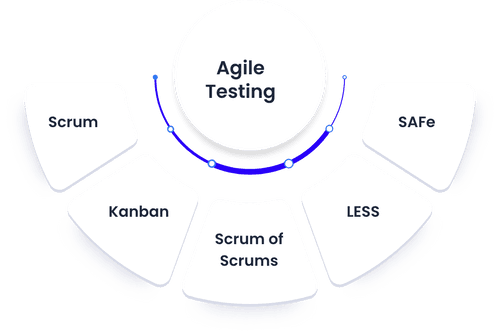
Appsierra delivers Agile testing through expert-supervised pods that embed directly in your sprints. Senior QA engineers build continuous test coverage with Selenium, Appium, and JMeter, gate each iteration behind measurable quality criteria, and scale the practice across teams using the Scaled Agile Framework (SAFe) so feedback arrives inside the sprint, not after it.
Four steps from first call to a pod that is measurably working. You are never more than two weeks from evidence.
Through Scaled Agile Framework (SAFe) testing services, Appsierra assists you in delivering continuous value. When you choose managed QA services to fulfill your long-term goals, we help you focus on key capabilities. How do we know? With over 100+ members, we were able to successfully integrate our team into an Agile-led program.
We start with the advanced Program Increment planning.
Divide the work among the team to expedite the process.
Maximize testing efforts by executing program backlog synchronization across teams.
We give continual all-around technical assistance.
To make quick decisions and boost release efficiency, we use customized metrics.
We deploy an Agile test automation pyramid to reduce risk at all levels.
To reduce workload, we offer seamless integration into your CI/CD pipeline.
We ensure a viable product is delivered as per requirements.












In Agile, testing is continuous rather than a separate phase bolted on at the end. QA is involved from sprint planning onward — reviewing user stories, clarifying acceptance criteria, and shaping testable requirements before a line of code is written. As developers implement each story, testers write and run checks in parallel, so defects surface within the same sprint they were introduced instead of weeks later.
This tight feedback loop is what makes Agile testing effective. Every user story carries a clear definition of done that includes passing tests, and automated regression suites run on each build so new work never quietly breaks existing features. The goal is a potentially shippable increment at the end of every sprint, with quality treated as a shared team responsibility rather than a gate someone else owns.
Shift-left testing means moving quality activities earlier in the delivery cycle — to the "left" of a traditional timeline — instead of concentrating them at the end. In practice, testers help write acceptance criteria, teams add unit and API tests as code is developed, and static analysis and security checks run before code is merged. Catching a defect at the design or unit stage is far cheaper and faster to fix than catching it in a release candidate.
Shift-left pairs naturally with Agile because both favour fast feedback. Practices like test-driven development, behaviour-driven development, and close pairing between developers and QA all push testing upstream. The result is fewer surprises late in a sprint and a more predictable path to a releasable increment.
In a Scrum team, the QA engineer is an embedded member of the cross-functional team rather than a downstream reviewer. They take part in every ceremony — refining stories in backlog grooming, committing to a realistic scope in sprint planning, flagging risks in the daily stand-up, and demonstrating tested work in the sprint review. Their job is to build quality in, not to inspect it afterwards.
Day to day, a QA engineer designs test cases from acceptance criteria, automates repetitive and regression checks, performs exploratory testing to find issues scripts miss, and helps maintain the test automation pyramid so the suite stays fast and reliable. Because they sit inside the team, they can advocate for testability, keep the definition of done honest, and give the product owner a clear, current picture of release readiness.
An agile software testing service is not a block of hours you spend on regression at the end of a release. It is testers embedded in your sprint cadence, working to your definition of done, in your tracker and your pipeline. Concretely that means someone in refinement turning vague stories into testable acceptance criteria, functional and exploratory coverage of each story inside the sprint it was built, an automated regression suite that grows with the product and runs on every build, and a release-readiness view the product owner can actually act on at the end of the sprint.
What it does not include is a separate sign-off stage. If an engagement adds a testing phase after development finishes, it has recreated the waterfall gate that agile exists to remove, and the feedback loop that makes agile testing worth paying for is gone. That distinction is worth pressing any prospective partner on, including us.
The honest answer is that the first sprint is slower, and any partner who tells you otherwise is selling. A new tester needs the domain, the architecture, the existing suite and the team's working agreements before they are additive. What a competent engagement does is make that ramp short and visible rather than pretending it does not exist: a defined first-sprint scope, pairing with your engineers, and a written picture of current coverage so everyone can see what is and is not protected today.
The failure mode to avoid is a parallel QA team running its own board and its own cadence. That produces duplicated effort, defects raised against work already changed, and a growing sense that testing is something happening elsewhere. Embedded testers attend your ceremonies, pull from your backlog, and are accountable to the same increment as the developers next to them. Where you need that capacity supervised and accountable as a unit rather than as individual contractors, our managed QA pods are the same people under a single delivery owner.
Each answer is written to stand on its own, so an assistant can quote it without the surrounding page.
Appsierra's expert-supervised QA pods bring continuous testing, SAFe expertise, and CI/CD integration to de-risk every release. Connect with our experts to optimize your testing process today.
Tell us what you need to build, test, scale or hire for — QA, software, AI/LLM engineering or a full pod. A senior engineer reviews it and sends a short, honest read, plus a low-risk way to start.
Thanks — your request is on the way.
We'll review and follow up shortly.
Want it sooner? Book a 30-minute call and pick a slot now.