
The Future of Workplace Productivity in AI-Driven Software Companies
Software companies have always competed on speed, quality, and the ability to ship functional and reliable products faster than everyone else. But AI is changing the terms of that competition these days.
Software companies have always competed on speed, quality, and the ability to ship functional and reliable products faster than everyone else. But AI is changing the terms of that competition these days.
Companies that have figured out how to weave AI into daily development, testing, and quality assurance workflows early are shipping better software in less time and with smaller teams. The ones still treating AI as a side experiment are starting to feel the gap.
This is about changing what engineers spend their time on and how organizations measure the value of that time.
6 Ways AI Is Reshaping Productivity in Software Companies
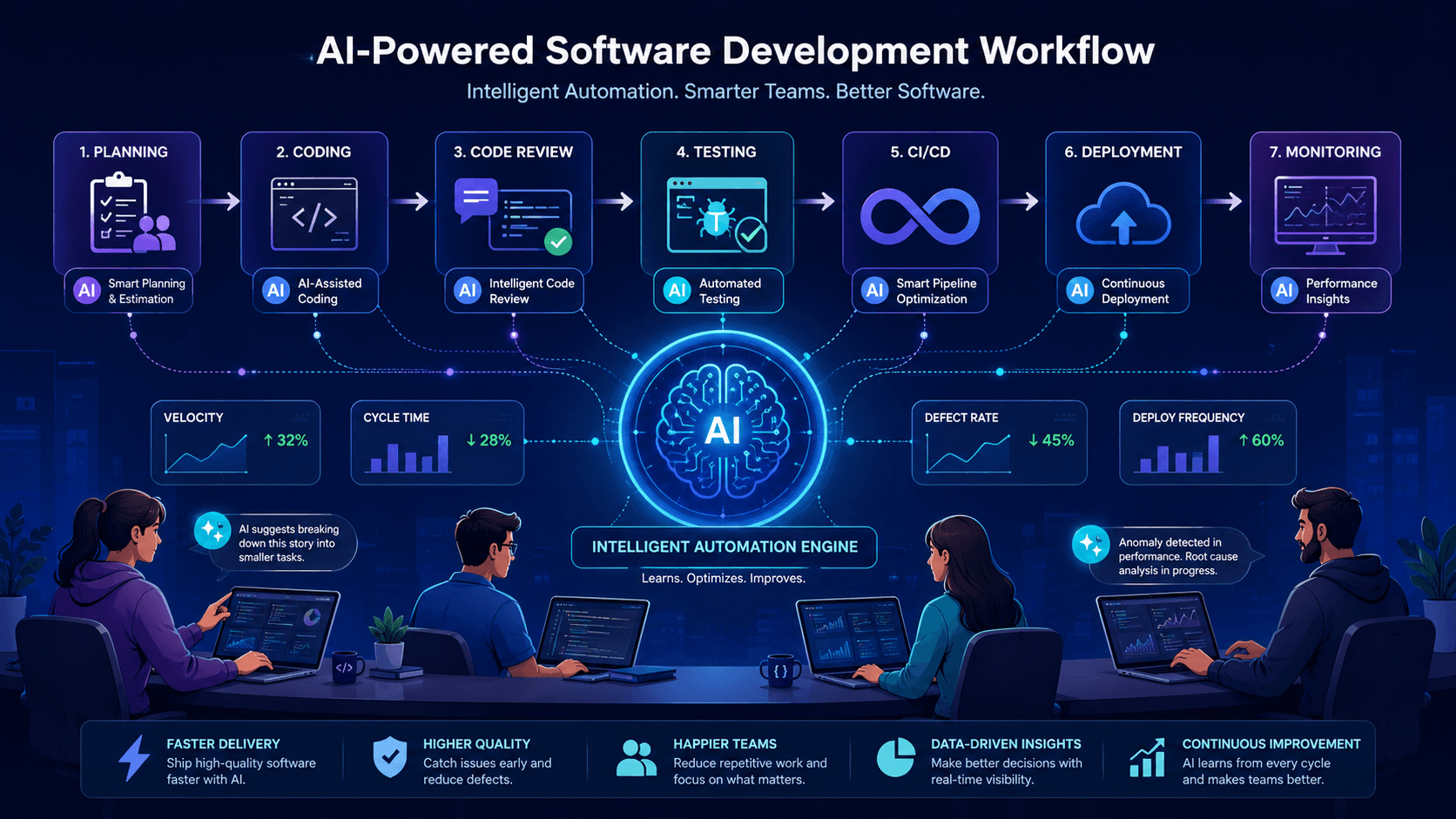 ### 1. Real-Time Visibility Into How Engineering Teams Work
You cannot improve what you cannot see.
For years, software team productivity was measured through proxies, story points, pull request counts, and lines of code. None of this told you whether a team was working on the right things or burning time on tasks that should have been automated.
AI-powered tools have changed this by surfacing how time is distributed across development, testing, and review workflows. To track productivity at workplace effectively in a distributed software company, teams need platforms that go beyond activity counts and show the patterns underneath, such as which workflows consume the most engineering time, where context switching is highest, and which team members are consistently underutilized or stretched beyond capacity. For teams looking beyond engineering-specific tools, AI tools for agency workflows can also help automate repetitive tasks, organize projects, manage client communication, and keep teams focused on higher-value work. These platforms can connect everyday workflows and reduce the time spent switching between disconnected tools.
Modern employee productivity platforms monitor application usage, active versus idle time, and work session patterns across remote and in-office engineers in a single dashboard. For software companies managing QA engineers, DevOps teams, and developers across time zones, this visibility enables managers to make resourcing decisions based on real data rather than assumptions formed in status meetings.
2. AI-Assisted Code Generation Shifts Developer Focus Upstream
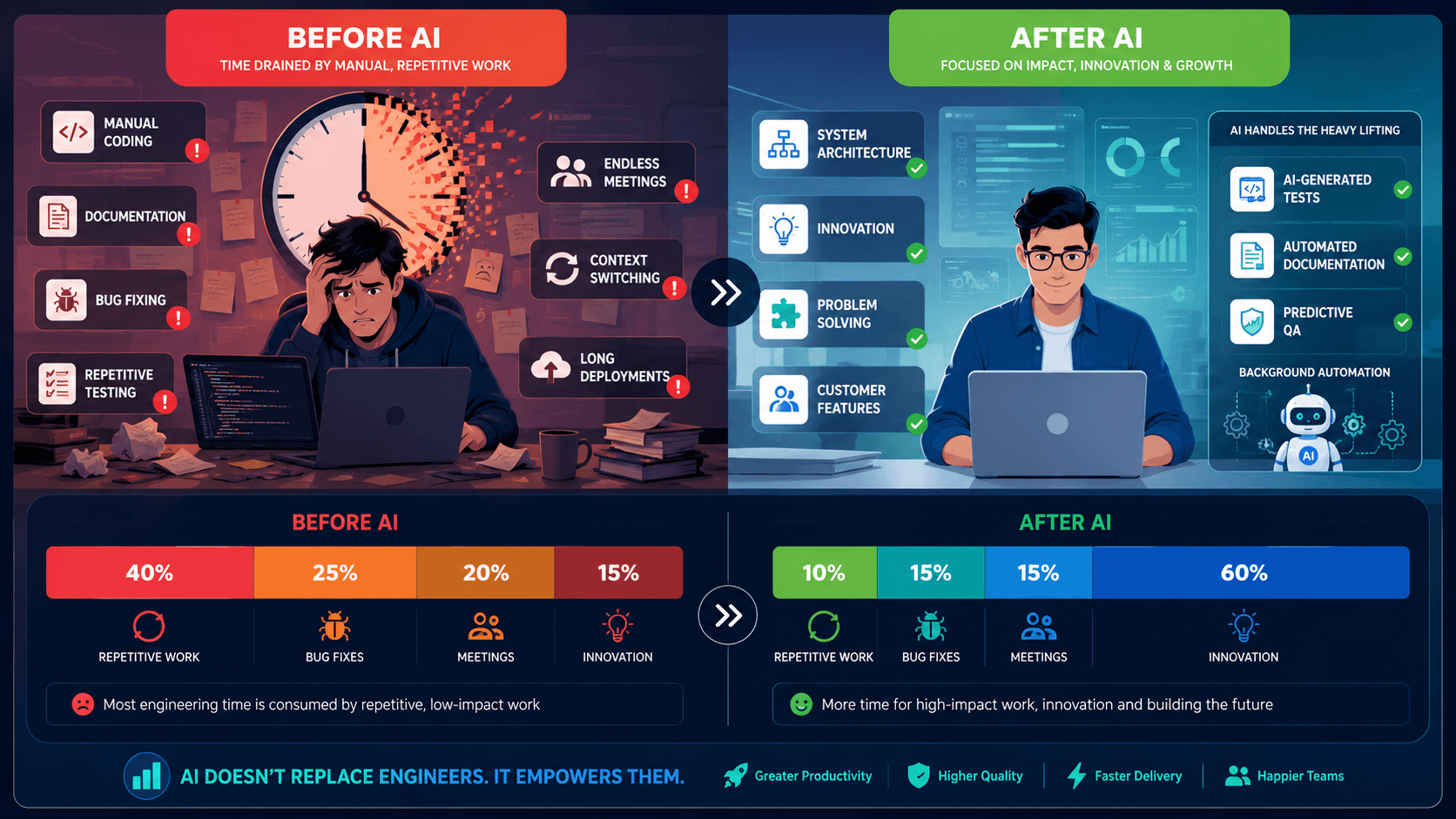
Boilerplate code, unit test scaffolding, and documentation consume a significant percentage of developer time without requiring the kind of judgment that makes a developer valuable. AI code assistants handle these tasks now, and the developers using them are spending more of their development time on architecture, design decisions, and the edge cases that matter.
The shift is already visible in engineering team outputs. Teams using AI-assisted coding tools are shipping initial builds faster and catching structural problems earlier. This is because developers who are not buried in boilerplate have more cognitive capacity for the problems that require them.
3. Automated Testing Frees QA Engineers for Exploratory Work
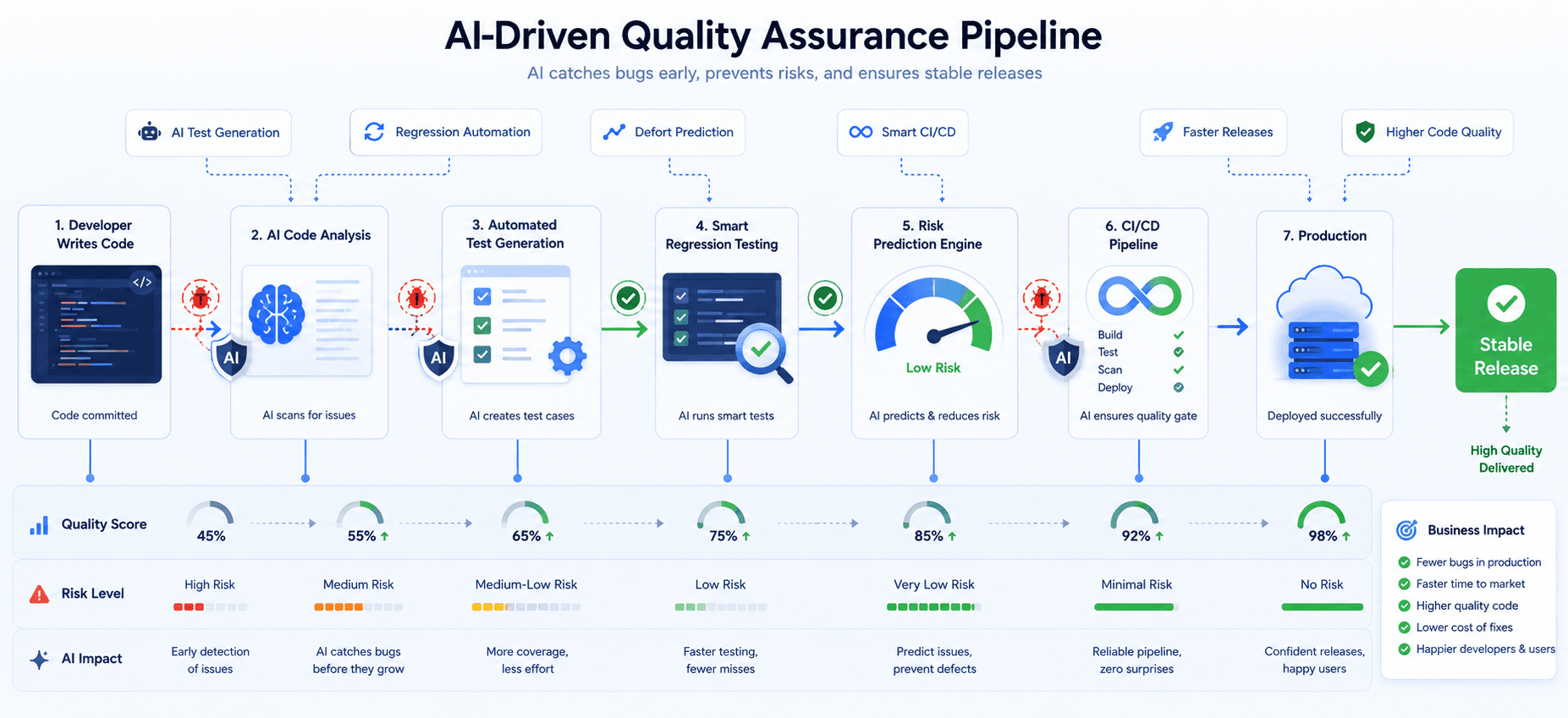
Regression testing has long been one of the most time-consuming parts of the QA cycle. Running the same tests across dozens of scenarios every time a change ships is the kind of mechanical repetition that AI handles better than humans do.
QA engineers get the most value from AI because testing services in software development are tough. With AI, those are the ones shifting toward exploratory testing and edge case identification. And human judgment is taken in strategic quality decisions. AI handles repetitive tasks while engineers handle thinking.
 ### 4. Continuous Integration Pipelines That Self-Optimize
Traditional CI/CD pipelines are static. They run the same tests in the same order that was mentioned. They do not check the changes made in the code.
Unlike this, AI-powered pipelines analyze each commit, identify the most relevant tests for the change, and prioritize changes accordingly. High-risk changes trigger comprehensive test suites. Low-risk changes move through faster.
The practical result is fewer pipeline bottlenecks and faster feedback for developers, who no longer have to wait for a full test run every time they push a minor update.
5. Intelligent Defect Prediction Before Code Ships
Catching a bug in production costs far more than catching it before release, in terms of engineering time, customer impact, and team credibility. AI models trained on historical defect data can identify code patterns linked to past bugs and flag them during development, before anything reaches deployment.
AI-first quality assurance is becoming the standard approach. Machine learning works as a co-pilot throughout the development cycle. Therefore, AI-driven automation is used to speed up test case generation and predict failure points before they reach production.
- Bugs are not detected after releasing the software. It’s now happening as a pre-release prevention
- Developers receive pattern-based warnings in real time as they write code to prevent bugs
- Teams spend less time on reactive fixes and more time building forward
6. AI-Driven Knowledge Management Cuts Onboarding Time
Every time a new engineer joins a team, companies lose weeks of productivity because that person needs time to figure out where things live, why past decisions were made, and how the codebase fits together.
AI-powered knowledge management tools index existing documentation, code comments, Slack threads, and past tickets to create a searchable organizational memory.
New engineers get answers in minutes rather than days. You no longer need to pull existing engineers into the same context-sharing conversations repeatedly.
The consulting and QA advisory approaches that leading firms apply to new client engagements increasingly rely on this kind of structured knowledge transfer. It aims to reduce onboarding friction and reach productive contribution faster.
 ## Productivity in AI-Driven Software Companies Belongs to Teams Who Instrument It
The shift to AI-driven software development does not happen automatically. It happens through deliberate decisions about which workflows to instrument, which tasks to hand over to AI, and how to measure whether productivity improvements are reaching the work that matters.
Software companies that treat productivity as something to measure and manage, rather than assume and hope, are shipping better work, retaining engineers longer, and catching quality problems before they reach customers.
The tools exist. The discipline is what determines whether they deliver.
Appsierra helps engineering teams build and maintain the quality infrastructure that makes AI-driven development reliable. Work with Appsierra to accelerate your team's output without compromising the quality standards your customers expect.
Ready to put this into practice?
Appsierra's expert-supervised QA and AI engineering pods help teams ship higher-quality software faster — with senior accountability and a low-risk pilot. Tell us what you're working on.